Ipamorelin research: a selective molecule meets patients
A molecule can do exactly what its designers hoped in a hormone experiment and still fail to establish a useful treatment.
The selective response was a real accomplishment
Novo Nordisk developed ipamorelin in the 1990s. The 1998 founding characterization examined primary rat pituitary cells, anaesthetised rats and conscious swine. Growth hormone rose; ACTH and cortisol did not rise above the levels seen with growth-hormone-releasing hormone, even at ipamorelin amounts more than 200-fold above its growth-hormone ED50. ED50 is the amount producing half the maximum measured effect in that experiment.
What is ipamorelin peptide? In chemical terms, it is a synthetic chain of five amino acids, designed from an earlier growth-hormone-releasing peptide. It acts at the ghrelin receptor rather than the growth-hormone-releasing-hormone receptor. The cell work and animal work established a distinctive hormone response. Patient benefit required a separate test.
The precision of that result deserves admiration, but it did not answer every later question. Selectivity was the accomplishment. Safe, useful long-term treatment was a different assignment.

The blood study timed a discrete pulse
The 1999 study in healthy male volunteers tested five dose levels, with 8 men per level, using 15-minute intravenous infusions. Drug kinetics were dose-proportional. Terminal half-life was approximately 2 hours, and the growth-hormone response was a discrete pulse peaking around 40 minutes.
This tells a useful story about a drug entering and leaving blood. It does not report improved sleep, stronger muscles or slower aging. The pulse interests me until someone tries to turn its timing into hours of relief. That next step would need a measured patient benefit.
The exact amounts and routes are in the experiment ledger.
Then the question became: can people eat sooner?
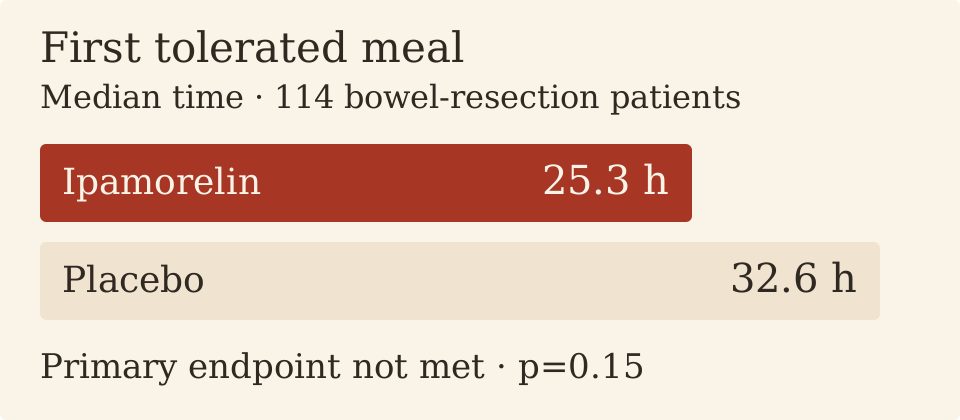
Postoperative ileus is the temporary slowing of the bowel after surgery. The published Phase 2 trial enrolled 114 adults undergoing bowel resection and tested whether ipamorelin shortened the wait for a tolerated meal. Median times were 25.3 hours with ipamorelin and 32.6 hours with placebo, with p=0.15. The primary endpoint was not met.
The earlier-looking time is tempting. I resist calling it a successful trial because the prespecified result did not establish efficacy. Other possible uses remain research questions. For this particular patient outcome, the needed demonstration of benefit failed to materialize.
Treatment-emergent adverse events occurred in 87.5% and 94.8% of the respective groups. Surgery, illness and treatment are all part of that setting; the totals do not identify drug-caused harms or establish long-term safety. No completed Phase 3 trial fills out the file.
Longer rat bones, unchanged total IGF-1
The 1999 rat bone-growth study used adult female rats treated for 15 days. At 18, 90 and 450 micrograms daily, longitudinal bone growth rates were 44, 50 and 52 micrometers daily, compared with 42 micrometers in the vehicle group. Total IGF-1, IGF-binding proteins and bone-turnover markers did not change.
The mismatch is more interesting than a simple growth-hormone-success story. Longer bones alongside unchanged systemic IGF-1 suggests a local or pulse-related contribution, without proving the cause. These were rat findings; they do not establish stronger human bones, less osteoporosis or a treatment for an injury.
Less weight lost is not more fat lost
In ferrets given cisplatin in 2024, ipamorelin reduced chemotherapy-associated body-weight loss by approximately 24% during the delayed 48–72-hour phase. It did not reduce acute or delayed vomiting. The study also tested another compound, but its anti-emetic result cannot be assigned to ipamorelin.
I had expected weight claims to be about losing it. This paper was about holding on to it. Neither the species nor the clinical problem matches a human fat-loss pitch, and the direction of the measured outcome makes that pitch particularly awkward.
Ipamorelin CJC-1295: pairing two hormone signals
What is CJC 1295 ipamorelin? It names a pairing of compounds with different routes to growth-hormone release. CJC-1295 mimics growth-hormone-releasing hormone; ipamorelin uses the ghrelin-receptor pathway characterized in the original experiments. That complementary action is the rationale for combining them.
Does CJC-1295 ipamorelin work? There is no human combination trial here establishing the advertised sleep, strength, recovery or fat-loss benefits. Separate single-agent pharmacology cannot become a clinical result for the pair simply because both names share a label. The later sports-medicine review still describes investigational evidence and uncertain safety, rather than reproducible human musculoskeletal benefit.
Ipamorelin vs sermorelin and ipamorelin vs tesamorelin raise a related confusion. Sermorelin and tesamorelin use the growth-hormone-releasing-hormone pathway and have different approval histories: a sermorelin form was approved in the past, and tesamorelin has an approved medical use. Ipamorelin has none. Shared effects on growth hormone cannot transfer an approval from one molecule to another.
A glycine addition changed the identified molecule
Ipamorelin laboratory research includes analytical work as well as experiments on living systems. The black-market product analysis and seized-material study identified glycine-modified analogues. Those ipamorelin test reports concern what was in the material. Treatment outcomes would require clinical work.
Research compound and research peptide describe the material’s research context. Ipamorelin research products are not established treatment merely because a test report accompanies them. Identity, purity, sterility, clinical benefit and approval answer different questions.
The newer reviews still ask for patient evidence
The gerontology review describes missing long-term safety data and unvalidated monitoring frameworks. The musculoskeletal and athletic-performance review finds scarce rigorous human evidence and potential for serious harm. The broader metabolic, endocrine and aesthetic review also calls for more human studies before most new peptides can be used safely.
I put these reviews at the back of the file, where they belong: they assess the unfinished evidence, rather than supply a new treatment result. A more recent publication date does not turn a review into a trial.